Can a bioclimatic pergola withstand wind and snow?
Reviews of bioclimatic pergolas often split precisely over wind and snow. We explain what their strength depends on and what you can do yourself.
Published: November 4, 20267 min read
When you look up bioclimatic pergola reviews, you quickly find two extremes: some people praise their pergola after years of strong wind, others describe bent louvres after the first heavy snow. Both can be true. Strength is not a property of “bioclimatic pergolas” in general but of the specific system, the specific size and the way it is fixed in a particular place.
In this post we explain simply how wind and snow act on a pergola, what to ask before you order and how to use the louvres and screens in bad weather. We do not give load figures as a promise: they depend on the system manufacturer and are checked for each project individually.
How snow and wind load a pergola
Snow presses down. Powder snow is light, but wet and compacted snow is many times heavier at the same depth. Build-ups are even more critical: against a wall, below a higher roof or where wind forms drifts, snow can be much deeper than in the garden. If the pergola sits below the eaves of the house, you must also allow for snow sliding off the roof onto it.
Wind works in two ways. From the side it pushes on posts and beams. On the roof it creates pressure or suction that tries to lift it. Suction in particular is often underestimated: the pergola must not only carry weight but be anchored so that the wind cannot tear it from its base or from the wall.
The two loads can act together, for example with wet snow and strong wind on the same day. That is why serious systems are designed to the European loading standards (Eurocode), taking into account the snow and wind zone of the site.
What a pergola's strength depends on
- The system: profile cross-section and wall thickness, louvre shape and how louvres are fixed to the beams.
- The span: the same system carries more with a shorter louvre and posts closer together. Manufacturers give permitted loads for specific sizes, not one figure for everything.
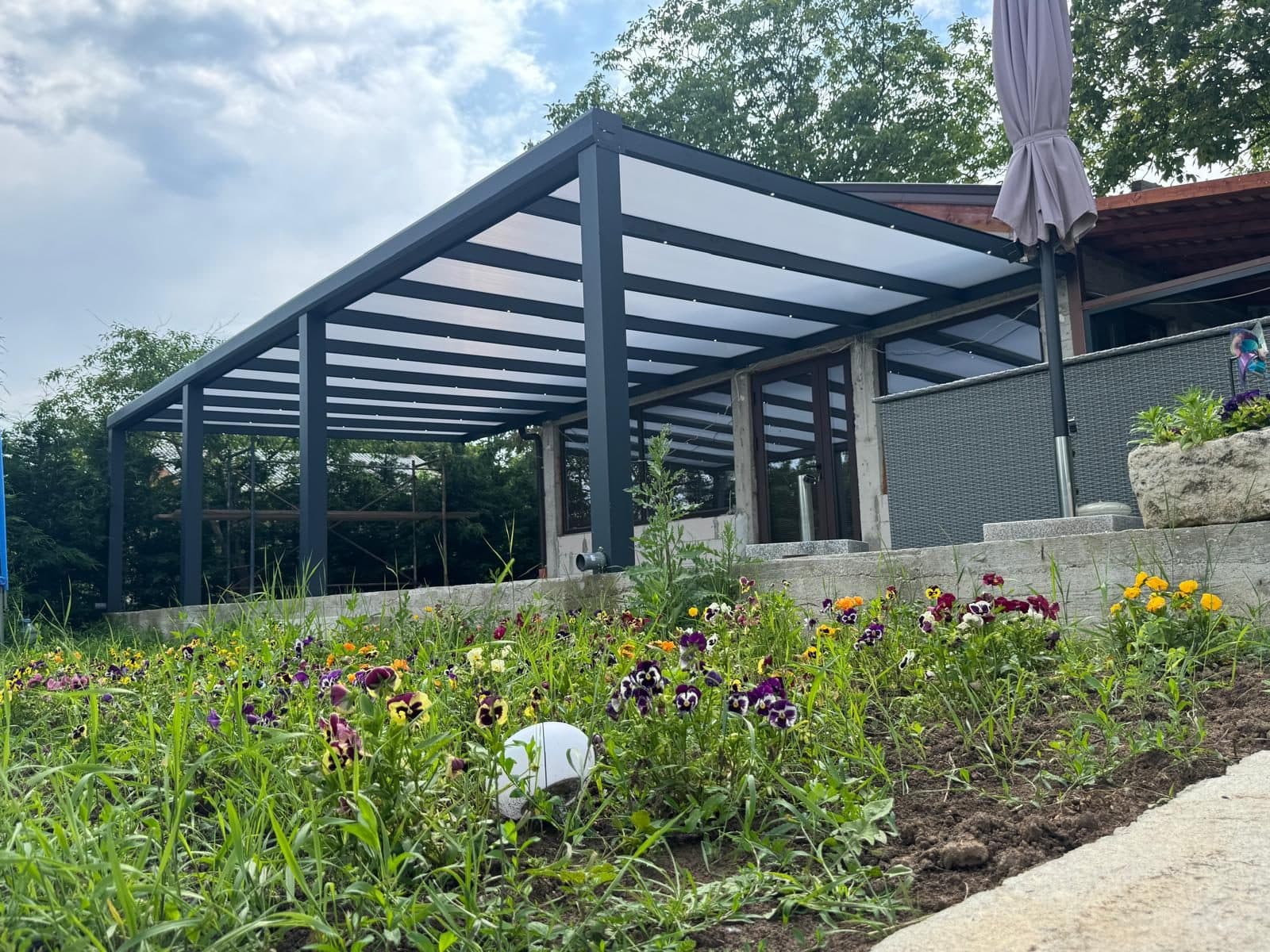
- Posts and anchoring: the number of posts, the size of the anchors and what they are fixed into.
- The foundation: a concrete slab or footing of sufficient thickness. Pavers on sand are not a base for anchors.
- The region: mountain areas have much higher snow loads, open plains and hills are windier. In North-East Bulgaria, including around Ruse, open sites are exposed to strong winds and wet snow is not unusual.
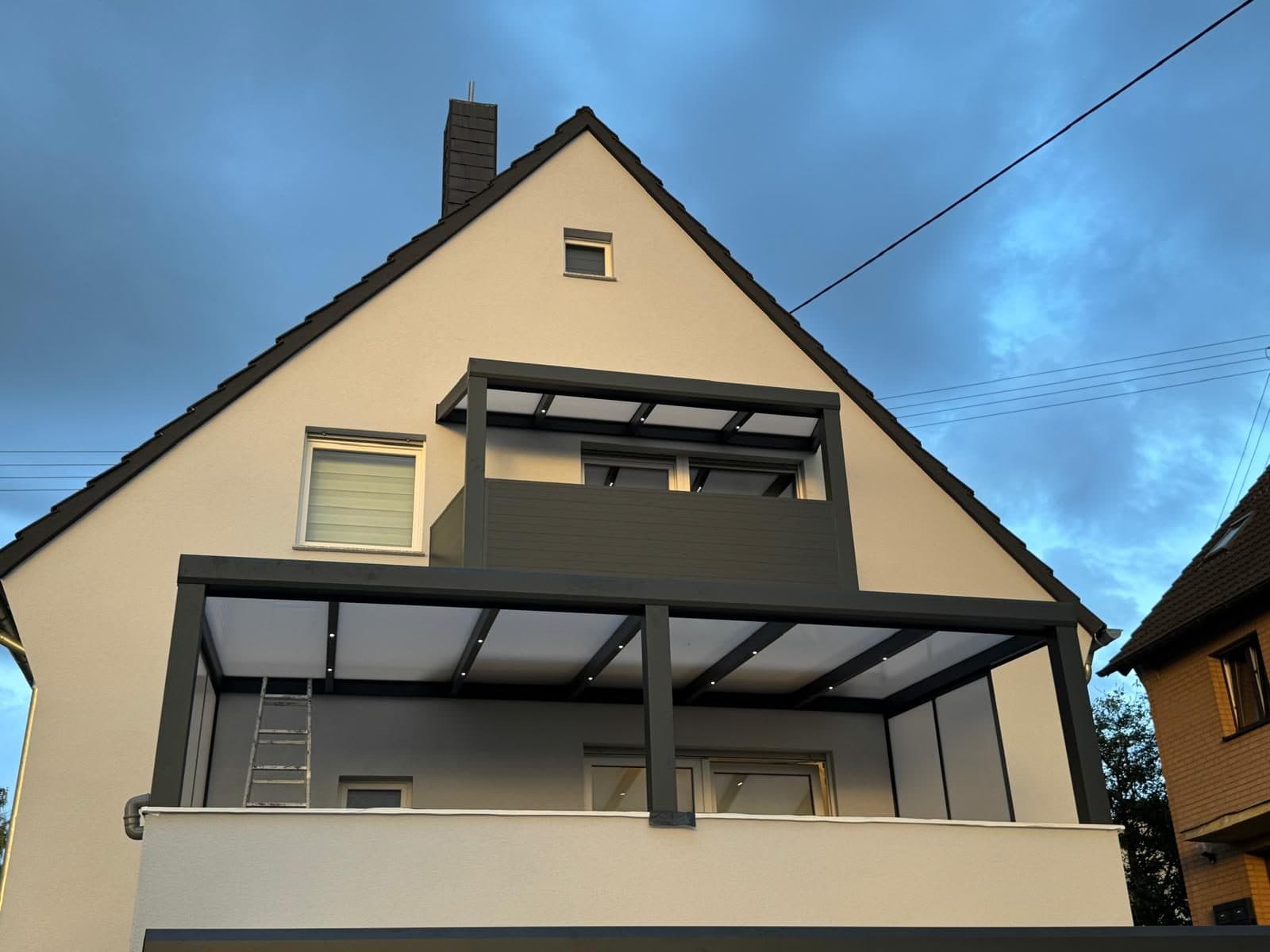
- Exposure: a pergola between two buildings behaves differently from one in an open garden or on a third-floor roof terrace.
What to ask before you order
- What snow and wind loads are permitted for your size, not for the smallest model in the brochure?
- How many posts will there be and where, and does the size need more than the standard number?
- How will it be fixed to the wall, and with what anchors if the façade is insulated?
- What foundation is needed and is the existing slab enough?
- What does the manufacturer advise for the louvre position in snow and in strong wind?
- Are side screens or glass included in the calculation? They change the load.
These answers are more useful than any general claim that the pergola “can take anything”. If you are not sure what to ask, we go through them together at the free site visit.
The louvres in storms and snow
A bioclimatic pergola has one advantage over a fixed roof: the louvre position can be changed. But the right position depends on the system, so always follow the manufacturer's instructions. Some general rules still apply to most systems:
- In strong wind many manufacturers recommend opening the louvres so air can pass through and suction on the roof drops. A wind sensor does this on its own.
- Don't rotate frozen louvres. With ice on them, the motor and mechanism can be damaged. Wait until it melts.
- In heavy snow follow the system's instructions. Some carry load closed, for others a different position is recommended.
- If the snow is unusually deep, carefully clear it from below with a soft tool, without climbing onto the pergola.
- Check the gutters and the drains in the posts in autumn. A blocked drain means water and ice stay on the louvres.
Side screens and glass in wind
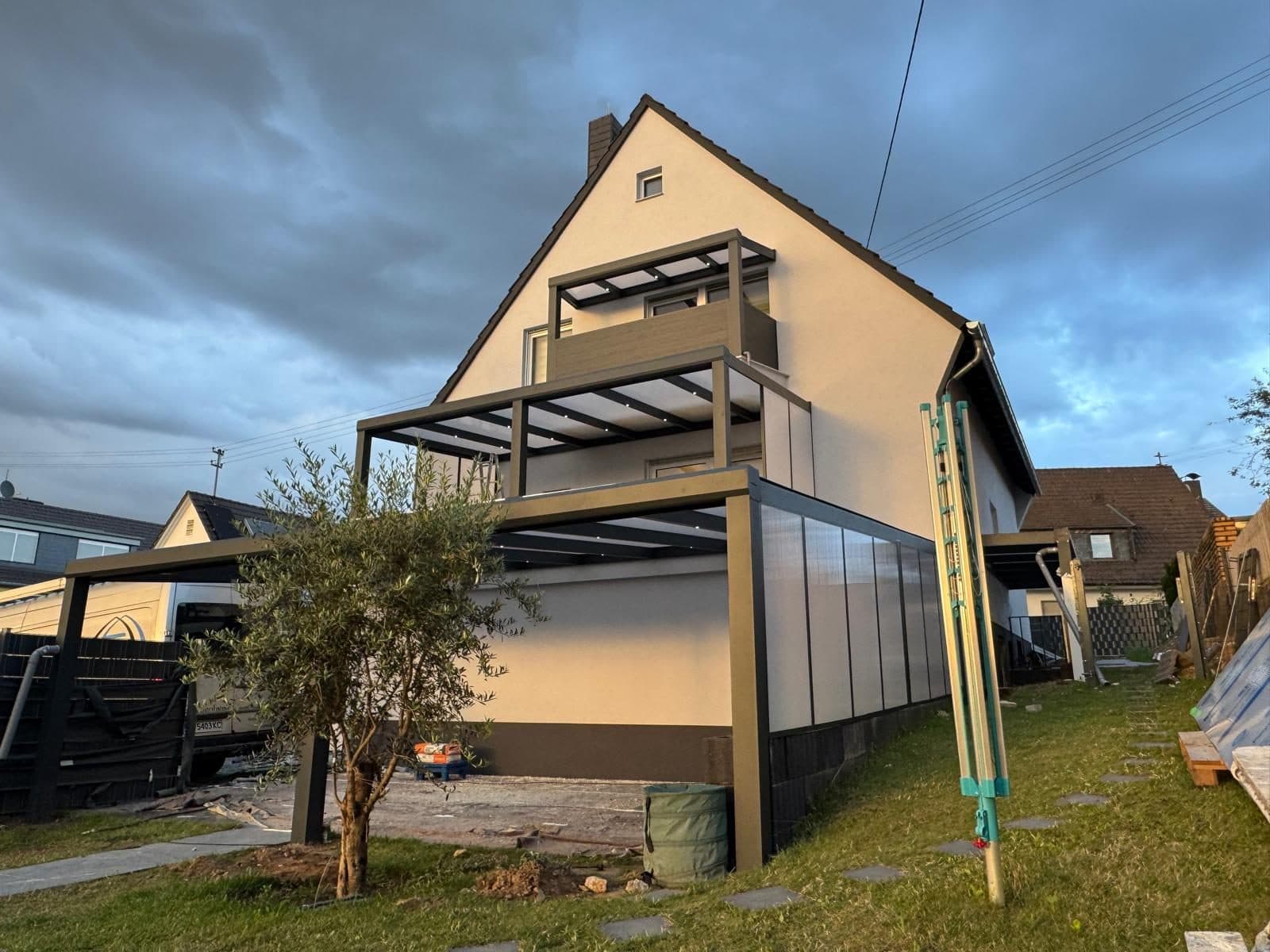
As soon as you close the sides, the pergola is no longer a “grid” that wind passes through. The closed side takes the pressure and passes it to the posts and anchors. That is why side enclosure must be planned in the calculation, not added later “by eye”.
ZIP screens are much more wind-resistant than ordinary outdoor blinds because the fabric is held in the side guides and does not flap. But they have a limit too, and should be retracted in a storm. More in our post ZIP screens – can they handle wind. Sliding glass makes the space more enclosed and cosy; here too it matters how the tracks are fixed top and bottom.
Why some reviews are negative
If you read complaints online, you will notice they are rarely about the idea of rotating louvres itself. The most common causes are:
- too large a span for the system, without an extra post;
- anchoring into pavers, sand or a thin screed instead of concrete;
- fixing to a wall that cannot take the load;
- screens left down during a storm;
- blocked gutters that fill with ice in winter;
- cheaper kits without a calculation for the specific site.
Most of these problems are avoided at the design stage. That is why our site visit includes checking the wall, the base and the exposure before we propose a size and number of posts. If you are comparing with a ready-made kit from a store, also read ready-made or custom pergola.
Maintenance before and after winter
- In autumn, clear leaves from the louvres and gutters.
- Check that anchor bolts and beam connections are tight.
- Test the sensors and manual operation before the frosts.
- After a strong storm, inspect the pergola for bent louvres or loose parts.
If you are considering a pergola for your garden or terrace and want it designed for your site, take a look at our pergolas and try sizes in the 3D configurator. We work all over Bulgaria. Book a free site visit so we can check the wall, base and exposure and suggest the right solution.
Frequently asked questions about pergolas in wind and snow
Can a bioclimatic pergola withstand snow?
A well-designed and properly anchored pergola withstands the snow load it was designed for. That depends on the system, the size and the snow zone of the site. So ask for the permitted load for your specific size.
Should I open the louvres in strong wind?
For many systems the manufacturer recommends opening the louvres in strong wind to reduce the load. The position depends on the system, though, so follow its instructions. A wind sensor can do it automatically.
Can I rotate the louvres when they are frozen?
No. With ice on the louvres the mechanism and motor can be damaged. Wait for the ice to melt and only then move them.
Can ZIP screens withstand wind?
They are more resistant than ordinary outdoor blinds because the fabric runs in side guides. Every system has a wind limit, though, and the screens are retracted in a storm.
Why do reviews say pergolas bend?
Usually because of too large a span, weak anchoring, a poor base or a cheap kit without a calculation. These problems are solved at the design stage, not after installation.